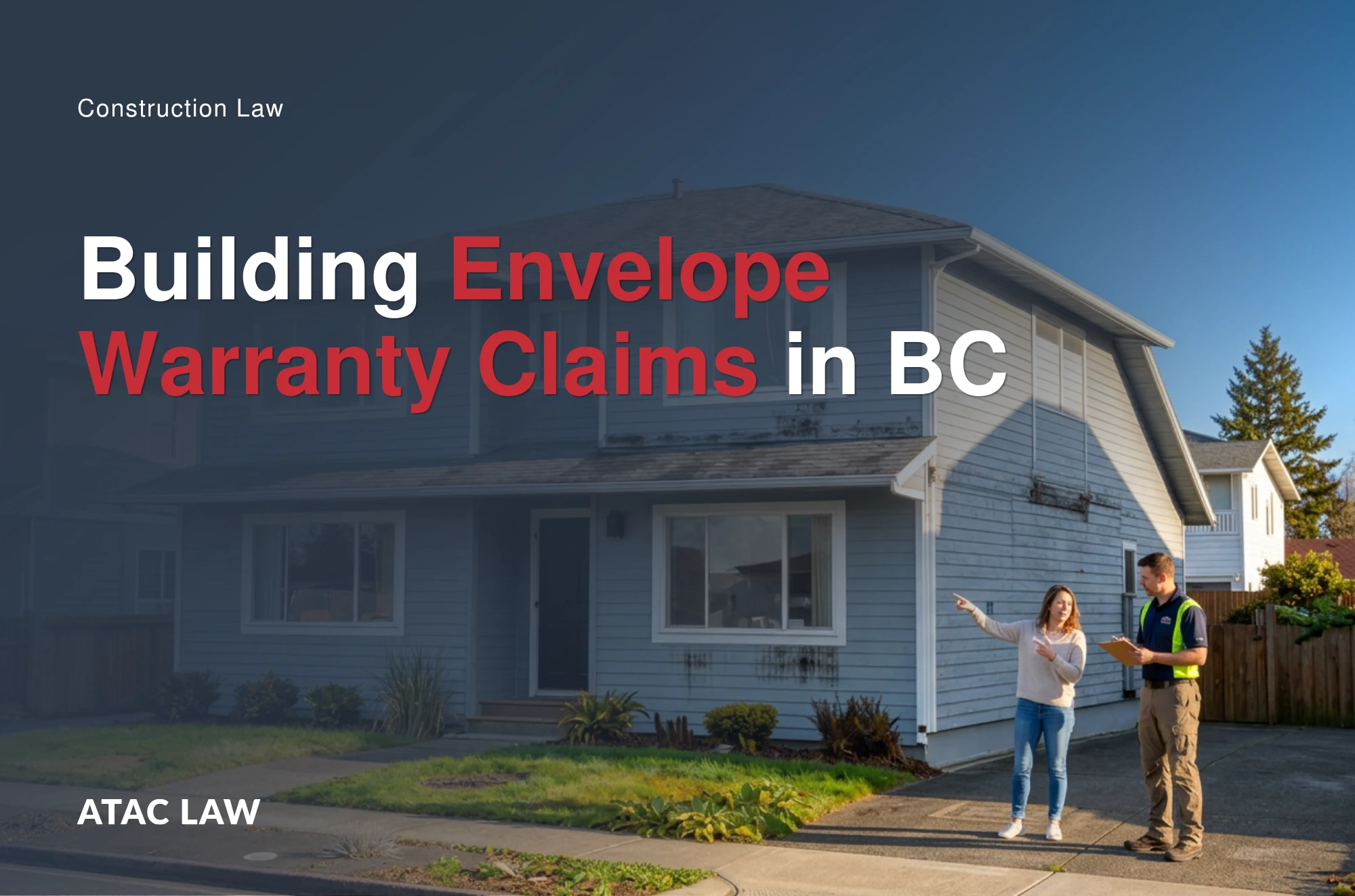
Building envelope warranty claims in BC are governed by the Homeowner Protection Act, which requires licensed residential builders to provide mandatory 5-year coverage for water penetration defects through exterior walls, roofing systems, cladding assemblies, and window integration.
The 5-year building envelope tier is the most technically complex and most frequently disputed component of BC’s residential warranty system. Unlike 2-year materials defects, envelope failures develop over months or years, meaning the discovery date and claim deadline are often just as contested as the defect itself. Homeowners who understand what qualifies as a covered defect, how to document failures before filing, and why claims get denied are significantly better positioned to recover repair costs from their warranty provider.
What Qualifies as a Building Envelope Defect in BC?
A building envelope defect under BC’s Homeowner Protection Act is any failure of the exterior assembly that allows water penetration into the building interior or causes measurable loss of thermal performance, including failures in exterior walls, roofing systems, cladding, flashing, window integration, and vapor barriers.
The Homeowner Protection Act (SBC 1998, c. 31) defines the building envelope broadly to capture the full weather-resistive and thermal barrier of the structure. Qualifying defects include:
- Water infiltration through exterior cladding systems, including stucco, fiber cement board, and wood siding
- Flashing failures at roof-to-wall intersections, dormers, and penetration points such as exhaust vents and utility penetrations
- Window and door integration defects that allow water infiltration around frames or through compromised rough opening seals
- Vapor barrier failures that permit moisture accumulation within wall assemblies, leading to mold growth and structural decay
- Roofing defects involving underlayment failure, improper drip edge installation, or roofing membrane deterioration
Cosmetic deficiencies that do not affect the weather-resistive or thermal performance of the envelope fall outside the 5-year tier. Caulking discoloration, minor surface staining, and paint peeling without underlying moisture damage do not qualify. The test is whether the defect produces a functional failure in the envelope system, not whether the appearance is unsatisfactory.
How Long Does Building Envelope Warranty Coverage Last in BC?
Building envelope warranty coverage in BC runs for 5 years from the date of first occupancy or the date the warranty certificate is issued, whichever comes first, and this coverage transfers automatically to subsequent owners when the property changes hands.
The 5-year envelope period sits between the 2-year materials and labour tier and the 10-year structural defect tier. ATAC LAW has published a full breakdown of all three coverage tiers and their associated coverage limits in its guide to BC new home warranty coverage. For building envelope claims specifically, the 5-year clock begins on the first occupancy date, and this date is recorded in the warranty certificate issued to the original purchaser.
Coverage limits under the Homeowner Protection Act apply per dwelling unit. Single-family detached homes receive combined warranty coverage up to $200,000. Strata buildings carry additional per-building coverage for common property components, including the exterior envelope assembly. Those strata-specific rules are addressed separately below.
A critical limitation applies to the coverage period: the 5-year period cannot be suspended or extended by an ongoing dispute. Homeowners who discover potential envelope defects near the end of the 5-year period must file written notice immediately to preserve their claim rights within the coverage window.
How to Document a Building Envelope Defect Before Filing
Homeowners filing a building envelope warranty claim in BC require a professional inspection report, a written defect notice, a timestamped photographic record, and repair cost estimates from licensed contractors to support their claim through warranty provider review.
The four essential documentation steps are:
- Professional inspection report. Hire a building envelope consultant or registered home inspector to prepare a written report identifying the defect, its cause, and its relationship to the exterior assembly. Building science firms use moisture meters, infrared thermal imaging cameras, and blower door pressure testing to produce objective, measurable evidence of failure. A verbal assessment is insufficient: the warranty provider requires a written report signed by the inspector.
- Timestamped photographic record. Photograph all visible water intrusion, staining, efflorescence, mold growth, or deteriorated materials. Include photographs from inside opened wall cavities when accessible. Timestamps on photographs establish the discovery date, which starts the limitation clock under BC’s Limitation Act (SBC 2012, c. 13).
- Written notice of defect. Serve written notice of the defect on both the warranty provider and the original builder within the 5-year coverage period. Written notice by registered mail creates a documented record. BC’s Limitation Act imposes a 2-year limitation period for warranty litigation running from the date of discovery, but the warranty coverage period itself applies as an absolute threshold.
- Repair cost estimates. Obtain written estimates from licensed general contractors or building envelope restoration specialists. The warranty provider uses these estimates to assess the claim value against the applicable coverage limit and to determine whether the approved scope matches the documented defect.
How to File a Building Envelope Warranty Claim in BC
To file a building envelope warranty claim in BC, homeowners submit a written claim to the warranty insurance provider named on the home warranty certificate, attaching the inspection report, photographs, and repair estimates, and the provider is required to issue a written decision following a site inspection.
The warranty insurance provider, not the original builder, administers warranty claims under the Homeowner Protection Act. BC’s primary residential warranty providers are certified and regulated by the BC Financial Services Authority. BCFSA publishes guidance on homeowner rights under the Homeowner Protection Act, including the obligations of warranty providers and the dispute resolution options available to claimants. The claim process follows four stages:
- Submit written claim. File the claim with the warranty provider by registered mail or the provider’s online submission portal. Include the warranty certificate number, the property address, the date of discovery, and all documentation assembled in advance.
- Provider acknowledgment. The warranty provider acknowledges the claim and assigns an adjuster to the file. BC regulations require a written acknowledgment within a set period, and failure to acknowledge triggers escalation rights available to the claimant.
- Site inspection. The warranty provider’s adjuster or appointed building science consultant attends the property to assess the defect. Homeowners have the right to have their own building envelope consultant present during this inspection to ensure the assessment is complete and accurate.
- Written decision. The warranty provider issues a written decision: approved (repairs proceed through the provider’s approved contractor network or reimbursement is made), partially approved with a defined repair scope, or denied with written reasons. Each decision category carries distinct follow-up rights.
If the warranty provider decides a claim involves a warrantable defect, the warranty provider will cause the builder to repair the defect in most cases. You do not have the right to select your own contractor to perform the repair.
If the warranty provider denies the claim or disputes the repair scope, homeowners have the right to request a second inspection, submit additional expert evidence, and refer the dispute to binding arbitration under the warranty policy terms. Legal counsel should be engaged before accepting a final denial.
Common Reasons BC Building Envelope Warranty Claims Are Denied
Building envelope warranty claims in BC are most commonly denied because the defect is discovered outside the 5-year coverage period, because the warranty provider classifies the damage as owner-caused, or because documented maintenance failures are found to have accelerated an otherwise covered defect.
Understanding denial grounds allows homeowners to anticipate insurer arguments and address them in the original filing. The four most frequent denial categories are:
- Coverage period expiry. The homeowner discovers water damage after the 5-year envelope period has closed. Warranty providers apply strict date rules: even if the defect originated during the coverage period, a claim filed after expiry is denied unless the homeowner can demonstrate the defect was actively concealed by the builder.
- Owner-caused damage. The warranty provider attributes water intrusion to owner modifications, such as improperly installed deck additions that penetrate the cladding system, satellite dish installations that breach flashing seals, or landscaping changes that redirect drainage against the foundation.
- Maintenance failure. BC home warranty insurance requires homeowners to maintain the building envelope according to manufacturer specifications. Caulking around windows that was visibly deteriorated and never re-applied, for example, may void coverage for resulting water damage on the basis that the homeowner failed to maintain the sealing system.
- Exclusion misclassification. Certain envelope elements, including some pre-painted surfaces and pre-finished cladding components, may be classified as materials under the 2-year tier rather than envelope components under the 5-year tier. Providers sometimes apply this classification broadly to reduce their exposure.
When a warranty provider issues a denial, the written reasons must be reviewed carefully against the full policy wording and the Homeowner Protection Act regulations. Providers sometimes apply exclusions that are not supported by policy language or classify defects incorrectly. A construction lawyer reviews denial letters to identify whether the provider has misapplied coverage rules.
Legal Options After the 5-Year Building Envelope Warranty Expires
When a building envelope defect is discovered after the 5-year warranty period closes, BC homeowners retain legal remedies including negligence claims against the original builder, claims under BC’s Limitation Act discovery rule, and licensing complaints to BC Housing.
The expiry of the warranty coverage period does not extinguish all legal remedies available to a BC homeowner. BC’s Limitation Act provides a 2-year limitation period running from the date a defect was discovered or was reasonably discoverable, not from the date of construction. A homeowner who discovers concealed wood rot caused by a vapor barrier failure in year 6 of ownership has 2 years from that discovery date to file a negligence claim against the original builder, subject to an ultimate 15-year backstop from the date the omission occurred.
Post-warranty claims carry different evidentiary burdens than warranty claims. A negligence claim requires proof that the builder departed from the standard of care applicable to a licensed residential contractor and that this departure caused the defect. Expert building science evidence is typically required. Limitation periods are strictly enforced, so homeowners who suspect a post-warranty envelope defect should obtain legal advice promptly.
Strata Buildings and Building Envelope Claims: Different Rules Apply
In BC strata buildings, building envelope warranty claims for common property components, including exterior wall assemblies, roofing systems, and balcony decks, are the responsibility of the strata corporation, and claim decisions are made by the strata council on behalf of all owners.
Strata buildings in BC carry distinct coverage structures under the Homeowner Protection Act. Common property envelope components receive combined coverage up to the per-building maximum specified in the warranty certificate, which exceeds the per-unit limits applicable to single-family homes. Individual strata unit owners do not file common property envelope claims directly: the strata corporation files the claim through its council, and all strata owners must be notified of the claim, the outcome, and the repair plan. The Strata Property Act (SBC 1998, c. 43) governs the obligations of strata councils in managing common property and pursuing warranty claims.
Strata owners who believe the council is failing to pursue a valid building envelope warranty claim have the right to call a special general meeting under the Strata Property Act. If the council refuses to act on a clearly valid claim, an affected owner can apply to the BC Supreme Court for an order requiring the council to file the warranty claim. This remedy is available because the council’s failure to pursue warranty coverage causes a measurable financial loss to all unit owners.
Individual strata unit owners retain warranty coverage rights for components within their strata lot boundary. Windows and doors designated as limited common property under the strata plan may fall within the individual owner’s claim rights rather than the strata corporation’s, depending on the strata plan configuration. Reviewing the strata plan before filing establishes which party carries the obligation to file.
ATAC LAW represents both strata corporations and individual unit owners in building envelope warranty disputes and post-warranty construction defect litigation across British Columbia. Homeowners and strata councils navigating warranty claim denials or disputes with warranty providers benefit from legal review before accepting any final decision from an insurer. Contact ATAC LAW’s construction law team to assess the strength of your building envelope warranty claim.
Frequently Asked Questions
How long does a building envelope warranty last in BC?
The building envelope warranty in BC lasts 5 years from the date of first occupancy under the Homeowner Protection Act. This 5-year period covers water penetration defects through exterior walls, roofing systems, cladding assemblies, and window and door integration.
Can I file a building envelope warranty claim if the defect appeared late in the coverage period?
Yes, as long as the claim is filed while the 5-year coverage period is still active. Homeowners who discover potential envelope defects near the end of the coverage period must serve written notice on the warranty provider immediately. If the defect was concealed by the builder and not reasonably discoverable, a construction lawyer evaluates whether legal remedies outside the warranty framework are available under BC’s Limitation Act.
Who files a building envelope warranty claim in a strata building?
The strata corporation files building envelope warranty claims for common property components. Individual unit owners file claims only for components within their strata lot boundary. Strata councils have a legal obligation under the Strata Property Act to pursue valid warranty claims on behalf of all owners, and owners can seek a court order if the council refuses to act.
What happens if my building envelope warranty claim is denied?
The warranty provider must issue written reasons for the denial. Homeowners can request a second site inspection, submit additional expert evidence from a building envelope consultant, and refer the dispute to binding arbitration under the warranty policy terms. A construction lawyer reviews whether the denial is consistent with the policy wording and the Homeowner Protection Act before the homeowner accepts a final decision.
Does the building envelope warranty transfer to a new owner when the home is sold?
Yes. The building envelope warranty transfers automatically to the new owner when a warranted property is sold in BC. The new owner has the same rights to file warranty claims for defects discovered during the remaining coverage period as the original purchaser had.