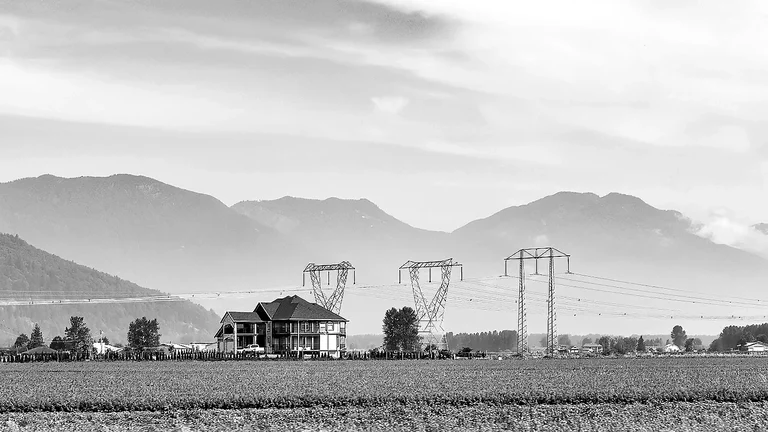
A transmission corridor can affect more than the ground beneath its towers. For a farm, ranch or timber operation, the value of the interest acquired, the effect on remaining land and losses during construction may each require separate assessment. The compensation available depends on how BC Hydro obtains the interest and on the terms of any agreement.
B.C. Reg. 228/2025 exempts both phases of the North Coast Transmission Line from specified certificate requirements under the Utilities Commission Act. It does not determine what a landowner must be paid. Phase 1 extends from the Prince George area to the Fraser Lake area; Phase 2 extends from the Fraser Lake area toward Terrace.
What changes on a working farm, ranch or woodlot when the corridor crosses productive land?
The terms of the right of way determine what BC Hydro may build, where it may enter and how the owner may continue to use the land.
A right of way does not necessarily transfer ownership of the land. It grants defined rights over it. The plan and granting document should be read together to establish the corridor width, tower locations, access rights, vegetation restrictions and limits on farming or forestry activities.
The operational effect depends on the parcel. A tower may interrupt machinery passes; a diagonal corridor may leave awkward field shapes; an access route may affect drainage, fencing or livestock movement. Those effects should be measured against the actual layout and use of the holding. The firm’s general guide to landowner rights and compensation on the North Coast Transmission Line addresses the wider project.
Which heads of compensation carry a loss to a farm operation?
First establish how the interest is being acquired. A negotiated right of way is governed by its agreement. If an interest is expropriated, the compensation provisions of the Expropriation Act apply. Section 3 of that Act also provides a route where an owner agrees in writing to transfer an interest but the parties leave compensation for the court to determine.
For an expropriation, section 31 sets the basic compensation formula. Where only part of an owner’s land is expropriated, section 40 addresses the market value of the interest taken and, to the extent its conditions are met, the reduction in market value of remaining land and reasonable personal and business losses. Section 34 addresses disturbance damages. The same loss cannot simply be added under several headings.
Section 31(2)(a) allows the value of a special economic advantage arising from the owner’s occupation or use to be added if it is not already included in market value. A useful field layout or water source does not automatically establish that separate advantage; the owner must prove its value and avoid double counting.
| Potential loss | Issue to establish |
|---|---|
| Right of way interest | The rights acquired and the market value of that interest, or the compensation agreed by the parties |
| Remaining land | A proven reduction in market value attributable to the taking or the construction or use of the works |
| Business operations | Reasonable personal or business losses meeting section 40(1)(b), where that section applies |
| Disturbance | Qualifying costs, expenses and financial losses under section 34, where applicable |
| Entry damage | Damage caused by or incidental to the exercise of BC Hydro’s section 20 entry powers |
The Expropriation Act also contains rules on valuation dates, benefits and the timing of certain claims. An owner should not assume that those rules automatically govern a privately negotiated settlement.
How are business losses on a farm, ranch or woodlot proved and timed?
A business loss requires evidence of its cause and amount. Under section 40(2), a claimed business loss is generally not determined until at least six months after it was sustained, unless the parties agree otherwise. That rule applies to determining the loss; it does not mean every claim must wait for a full production cycle.
Yield records, livestock inventories, timber cruises, invoices, financial statements and dated photographs can establish the operation’s position before and after the work. The analysis should distinguish a permanent effect on land value from an operating loss during construction. Forecasts may be needed for future effects, but they require a sound factual basis.
Section 34(4) permits an additional amount, up to the value of business goodwill, if the court determines that relocating the business is not feasible. It is not an automatic payment whenever a farm or ranch cannot readily move. The firm’s guide on what to do when a government expropriation offer is too low discusses reviewing an offer against the applicable compensation heads.
How do tower placement and severance affect field work, irrigation and drainage?
The position of the corridor and structures may matter as much as the area affected. Section 40(1)(b)(i), where applicable, addresses a reduction in the market value of land remaining after a partial taking.
Section 40(3) permits a before-and-after valuation of the land and provides a statutory minimum, subject to its terms and an appropriate reduction where the interest acquired is less than fee simple. Section 40(5) permits an adjustment if the land taken was more or less valuable than the average of the land retained. Neither provision replaces evidence about the particular holding.
An irrigation pivot, buried main, drain, ditch or field entrance should be located on a plan before terms are settled. Repair costs, operating losses and an effect on remaining land value may call for different evidence. Their treatment depends on the cause of the damage, the acquisition method and the agreement.
What does Agricultural Land Reserve status add to the negotiation?
Agricultural Land Reserve status creates a separate regulatory issue. Notice of a proposed statutory right of way does not itself establish permission for every construction activity on the land.
Section 18.1 of the Agricultural Land Commission Act requires notice to the Commission before an application to register a statutory right of way over reserve land. The registrar requires proof of that notice. The firm’s guide to what landowners should review before signing a BC Hydro right of way agreement discusses the registration step.
Non-farm use and soil or fill activities require separate review under sections 20 and 20.3. Depending on the activity, permission may arise under the Act or regulations, through an approval, or through the notice process prescribed by section 20.3. Its 60-day provision applies only when the specified notice, fee and response requirements are met.
The Agricultural Land Reserve Use Regulation permits certain infrastructure and aggregate activities subject to conditions. Its listed permission for specified pipelines and water lines in an existing dedicated right of way should not be assumed to cover an electric transmission line. Before signing, an owner should identify the proposed use, any required permission, the proposed soil work and the party responsible for compliance.
What happens to timber and to managed forest classification in the corridor?
The amount and ownership of timber to be cleared must be established from the clearing plan and the right of way terms. Clearance should not be assumed to mean that every tree across the full corridor width will be removed.
Section 10(c) of the Agricultural Land Reserve Use Regulation designates producing and harvesting timber, including silviculture and forest protection activities, as a farm use on reserve land. That designation does not itself determine compensation for timber loss.
Private managed forest land raises a further issue. The Private Managed Forest Land Act sets a reforestation objective for timber harvested or destroyed and provides for an exit fee in specified circumstances following declassification. Section 3(1) of the Private Managed Forest Land Regulation exempts a qualifying portion of land subject to a right of way or easement, or expropriated, from that fee. Other conditions also matter: no exit fee is payable under section 2(5) once the property has been classified as managed forest land for at least 15 years, while section 3(2) addresses declassification following an owner’s notification. The classification and affected area should be checked before an owner withdraws a management commitment.
What covers livestock, fences and biosecurity during construction?
Access terms should identify who may open gates, how fences will be reinstated, where equipment may travel and how incidents will be reported.
Damage associated with BC Hydro’s statutory entry powers may fall under section 20(2) of the Hydro and Power Authority Act. Contractual obligations and other causes of action depend on the documents and facts. Section 31 restricts actions against BC Hydro based on nuisance or the rule in Rylands v. Fletcher unless BC Hydro was negligent; it should not be treated as a general requirement of negligence for every type of claim.
The Livestock Act prohibits leaving a gate open or creating a fence gap when livestock might escape in the circumstances specified by section 19. Section 11 addresses an owner’s liability for damage caused by livestock at large and contains an exception where escape resulted from an act or omission of someone outside the owner’s control. Those provisions do not replace proof of the cause and value of a particular stock loss.
Biosecurity terms can specify access routes, equipment cleaning, notice and measures around livestock. Their content should reflect the operation rather than assume a single protocol works for every parcel.
Who pays for damage to crops, shelterbelts and other growing things?
Section 20(2) of the Hydro and Power Authority Act covers damage to crops, gardens, shrubs, trees and other growing things, as well as other damage caused by or incidental to the exercise of the section 20 powers. If the amount is not agreed, the Supreme Court of British Columbia determines compensation.
A claim should record where and when the entry occurred, the condition of the land beforehand and the damage attributed to the work. A shelterbelt may have a value to the operation beyond the price of replacement trees, but the claimed loss still requires evidence. The firm’s guide to danger tree removal outside the right of way addresses trees beyond the registered corridor.
Fresh damage in a later season should be documented separately. Section 20 states no specific claim period, but that does not mean an owner may delay indefinitely. A proposed release should also be reviewed for its effect on later damage.
Which terms cover temporary workspace, restoration and long term vegetation management?
Temporary workspace, laydown areas and construction access should be identified on plans. The agreement should state their permitted use, duration, payment terms and restoration standard, including where an area overlaps the permanent corridor.
Claims arising after signature are discussed in the firm’s guide to BC Hydro construction damage claims after signing a right of way. On productive land, a restoration schedule can address topsoil, compaction, drainage, fences, gates, weeds and the timing of work. Vegetation provisions should also identify access and notice requirements after the line enters service.
The Weed Control Act places duties on occupiers of land. Responsibility for weeds introduced or spread by construction should therefore be addressed expressly in the agreement rather than left to a general restoration clause.
The Integrated Pest Management Act applies to BC Hydro. The Integrated Pest Management Regulation contains requirements that depend on the proposed pesticide use and area treated, including confirmation and consultation requirements for qualifying utility corridor work. Its general 10-metre pesticide-free zone is subject to specified exceptions. An owner concerned about organic certification, seed production, water sources or grazing should address treatment methods and notice in the agreement as well as reviewing the applicable regulatory process.
Advice on North Coast Transmission Line compensation for farms, ranches and timber land
The assessment begins with the proposed grant, the parcel plans and the operation’s records. Those materials show what interest is being acquired, how access and structures affect the remaining land, and which losses require separate valuation. Construction lawyers at ATAC LAW represent landowners to support for their expropriation related matters.
Terms covering access, restoration, fencing, drainage, timber and vegetation are best examined before signature. Where construction is under way, dated records are needed while the condition of the land and the work remain observable. Enquiries may be made through the firm’s contact page. Meetings are arranged by appointment.
Frequently asked questions
BC Hydro has made an advance payment. Does accepting the money close off a loss that only appears in a later season?
It depends on the basis of payment and any document signed with it. For an advance payment under section 20 of the Expropriation Act, receipt does not itself prevent the owner from seeking a court determination. Section 25 nevertheless deems an expropriated owner to have accepted that payment in full settlement if the required court application is not made within one year. A payment under a negotiated agreement must be assessed under that agreement; it should not automatically be treated as a statutory advance payment.
Does a tenant farmer or grazing lease holder have a claim separate from the owner’s claim?
Potentially. An expropriated leasehold is a separate interest, and section 31(3) calls for separate valuation where practical. Section 39 addresses disturbance damages for a lessee under a lease with a term longer than one year. Sections 36 and 39 have different requirements, and a grazing licence or informal arrangement should not be assumed to have the same status as a lease. The documents and the rights actually held must be reviewed.
Does a grazing licence or permit on Crown range crossed by the corridor carry compensation?
A physical crossing does not, by itself, establish a payment under the Range Act. If the minister deletes land from a licence or permit because it is required for an incompatible use, sections 37 to 40 address notice, qualifying reductions in animal unit months or hay, and specified range developments. Compensation under those provisions is payable by the government, and a dispute about its amount goes to arbitration under section 41. Section 45(4) excludes application of the Expropriation Act to a taking, deletion or reduction under the Range Act. Deeded land and Crown range rights must be assessed separately.
Does a farm need an agrologist or a forestry valuation, and who arranges that work?
The necessary evidence depends on the loss claimed. An appraiser may assess the acquired interest and remaining land; an agrologist, farm business specialist or forest professional may be needed for production, livestock or timber issues. ATAC LAW can coordinate that work through counsel. The reasonableness and recovery of expert costs depend on the applicable statutory provisions, the outcome and the court’s determination; commissioning an expert does not guarantee reimbursement.
Who keeps the logs when timber is cleared from the corridor, and what must happen before they leave the property?
Ownership and disposition of merchantable timber should be settled in the agreement. The Forest Act contains timber-marking requirements for unscaled timber removed or transported from private land and scaling requirements before specified sales, manufacturing or transport. The required mark and arrangements for scaling depend on who has authority to harvest and what will be done with the timber. A pre-clearing inventory can support the decision to retain logs or seek compensation for their value.
Does a second parcel that the corridor never crosses come into the claim?
Possibly. Section 40(6) of the Expropriation Act includes nearby land in a partial-taking analysis where its value was enhanced by unified ownership with the land expropriated. Common operation alone does not prove that enhancement. Parcel ownership, distance, access and valuation evidence matter. The firm’s guide to which properties the North Coast Transmission Line crosses explains how to check the route against title. Where no land of an owner is taken or acquired, a potential claim under section 41 requires a separate analysis.