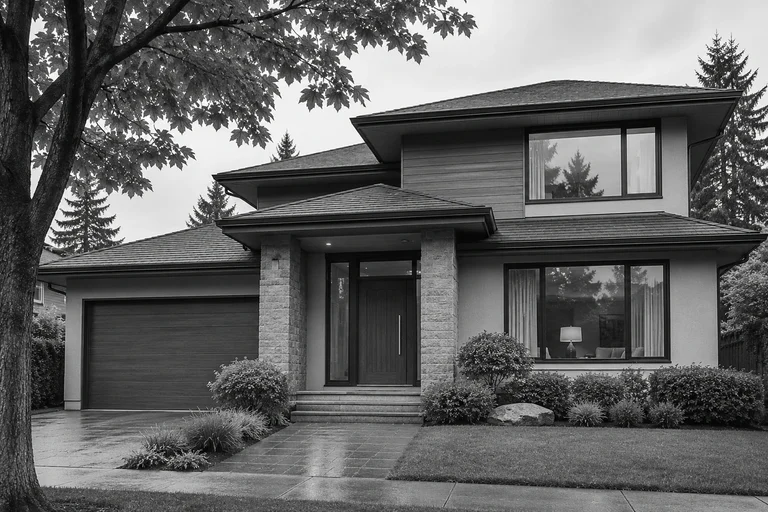
The Supreme Court of British Columbia ordered a builder to complete the sale of a newly constructed home for $845,000 plus GST, approximately five years after the original completion date. The property lacked an occupancy permit, had unresolved construction deficiencies and carried a new-home warranty that had commenced before the purchasers moved in.
In Adeyemi v. Industrial Radiator Co. Ltd., 2026 BCSC 1787, the Court found that the purchase agreement remained enforceable despite being prepared using an internet template. It ordered specific performance of the contract, with a reduction in the purchase price to account for outstanding deficiencies and other obligations.
How the Property Sale Became a Dispute
Industrial Radiator Co. Ltd. constructed a home in Duncan, British Columbia, but had not obtained an occupancy permit because required geotechnical documentation remained outstanding.
In June 2020, Opeyemi and Faye Adeyemi moved into the property under an arrangement involving monthly occupancy payments. They subsequently signed a purchase agreement on August 26, 2020, for $845,000 plus GST, with completion scheduled for June 30, 2021.
The agreement, prepared by one of the purchasers using an online template, required the builder to address specified construction deficiencies and provide new-home warranty coverage.
As the completion date approached, the builder had not obtained the occupancy permit or completed the necessary repairs. The parties also disagreed over deposit payments, monthly occupancy charges and their contractual obligations.
Why the Informal Contract Was Enforceable
Industrial argued that the agreement was too uncertain to enforce.
The Court disagreed. Although the document contained drafting problems, it identified the parties, property, purchase price and contractual obligations with sufficient certainty.
One disputed term concerned monthly occupancy payments. The purchasers believed those amounts would reduce the purchase price, but the written agreement expressly stated that they were not included in the house price. The Court enforced the written provision.
The ruling demonstrates that privately drafted agreements can create binding obligations even when their terms are imperfect. It also illustrates the financial consequences of failing to document arrangements accurately.
Why the Builder Could Not Terminate the Agreement
Industrial argued that the purchasers had failed to complete the sale by June 30, 2021, and that the contract had ended.
However, the Court found that Industrial was in essential default because it had:
- Failed to obtain the occupancy permit;
- Failed to provide the full new-home warranty required by the contract;
- Left agreed construction deficiencies unresolved; and
- Failed to arrange the necessary steps to provide clear title.
The Court found an implied contractual term requiring the builder to obtain an occupancy permit before completion. It also determined that the warranty contemplated by the agreement was a full new-home warranty, not the remaining coverage under a policy that had commenced in 2018.
Neither party was ready to complete on June 30, 2021. However, the agreement did not make time of the essence, and Industrial’s demand for completion on approximately one business day’s notice was unreasonable. The Court concluded that Industrial had wrongfully repudiated the contract.
The purchasers’ failure to make one $2,500 occupancy payment and their purchase of a separate townhouse did not establish that they had abandoned the transaction.
Specific Performance and the Price Reduction
The Court granted specific performance, requiring Industrial to complete the sale rather than pay damages in place of transferring the property.
The purchasers had lived in the home for more than five years and raised their children there. The Court accepted that the property had particular significance to the family and that their separately purchased rental townhouse was not an adequate substitute.
The Court allowed $31,500 for established repairs and work required to obtain an occupancy permit, with an additional $10,000 if the home-warranty commencement date could not be corrected.
After accounting for approximately $25,000 in credits to the builder for property taxes and municipal utilities, the Court ordered a net purchase price reduction of $16,500. That reduction would decrease to $6,500 if the builder obtained the required confirmation from the home warranty provider.
Completion was ordered within three months of the September 21, 2026 judgment.
What This Means for Builders and Purchasers
The decision demonstrates that outstanding construction deficiencies, occupancy permits and warranty obligations can affect a builder’s ability to insist on completion or terminate a sale agreement.
It also shows that an enforceable real estate contract can survive substantial delay and that specific performance may remain available when the property has particular significance to the purchaser. These issues frequently arise in real estate disputes and litigation.
For private sales involving pre-completion occupancy, clear contractual terms governing deposits, occupancy payments, repairs, permits and warranty coverage are particularly important.
ATAC LAW represents builders, developers, property owners and purchasers in construction litigation and real estate disputes, including disagreements over contractual performance, construction deficiencies and property sale agreements.